
What Happens Inside a Beehive at Night?

Updated: Aug 27
The Hidden Life of a Colony After Sunset
When the sun sets and the last foraging bees return to the hive, it might seem like everything goes quiet. But inside the hive, the opposite is true. Night-time is when some of the most important processes in a honeybee colony take place. Rather than resting, the hive becomes a carefully coordinated system of temperature regulation, communication, and internal work driven by thousands of individuals working as one.
The Hive Never Truly Sleeps
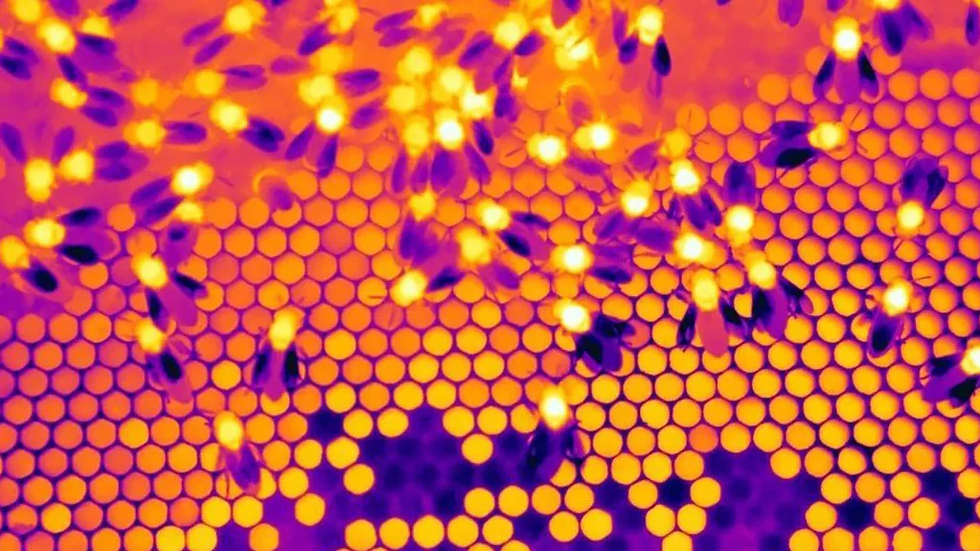
Unlike many animals, a honeybee colony does not shut down at night. One of its most critical responsibilities continues around the clock: maintaining a stable brood temperature of approximately 34–35°C. As external temperatures drop overnight, worker bees cluster tightly around the brood (developing larvae and pupae). They generate heat by vibrating their flight muscles without flying, a process known as endothermic heat production. Bees also rotate positions within the cluster, ensuring that no individual becomes too cold or overheated. This collective behaviour is a powerful example of thermoregulation at the colony level, where the hive functions almost like a single organism.
Night Shift Workers
While foraging stops after sunset, activity inside the hive continues. Younger worker bees, which typically do not leave the hive, take on essential roles during the night:
Nurse bees feed larvae with nutrient-rich secretions, including royal jelly.
Cleaner bees prepare empty cells for new eggs or food storage.
Wax workers build and repair the honeycomb.
Food processors continue converting nectar into honey.
This internal work is vital. Night provides uninterrupted time for maintaining the structure and future of the colony.
Ventilation and Honey Production

Even in complete darkness, bees actively regulate airflow inside the hive. Workers position themselves near entrances and across the comb, fanning their wings to circulate air. This serves several purposes:
Reducing moisture in nectar as it ripens into honey.
Maintaining stable humidity levels.
Preventing the growth of mould and pathogens.
To become honey, nectar must be reduced to around 17–18% water content. Without this continuous ventilation, proper honey storage would not be possible.
Communication in the Dark
Although bees are well known for the waggle dance, communication does not stop when the light fades. Inside the dark hive, bees rely on:
Vibrational signals transmitted through the wax comb.
Tactile communication via antennae.
Pheromones that regulate behaviour across the colony.
These systems allow bees to coordinate activity without relying on vision, making them highly adapted to life inside a dark, enclosed environment.
Do Bees Sleep?

Individual bees do exhibit sleep-like behaviour. At night, some workers become still, lower their antennae, and show reduced responsiveness to stimuli. However, this rest happens in rotating shifts. The result is that while individual bees may rest, the colony itself never stops functioning.
The Hive as a Superorganism
All of these processes, temperature control, labour division, ventilation, and communication, combine to form something remarkable: the honeybee colony behaves as a superorganism. Rather than acting independently, each bee contributes to a larger system that maintains stability, productivity, and survival. Night-time highlights this perfectly. When the outside world is still, the internal life of the hive continues in full force.
The Importance of Bees in Our Ecosystem
Bees play a crucial role in our ecosystem. They are responsible for pollinating many plants, which in turn supports the food chain. Without bees, many fruits, vegetables, and nuts would become scarce. This would have a significant impact on our diets and the environment. Supporting local beekeepers and purchasing products like handmade beeswax candles can help protect these vital creatures.
Final Thoughts
A beehive at night may appear calm from the outside, but within it, thousands of bees are working together in a constant, coordinated effort to sustain the colony. It’s a reminder that nature doesn’t simply switch off when the sun goes down, some of its most intricate and essential processes are happening in the dark. And perhaps that’s part of what makes bees so fascinating: even in silence, they are never truly still.
Further Reading & Sources
Seeley, T.D. (1985). Honeybee Ecology: A Study of Adaptation in Social Life. Princeton, NJ: Princeton University Press.
Heinrich, B. (1981). ‘The Mechanisms and Energetics of Honeybee Swarm Temperature Regulation’. Journal of Experimental Biology, 91(1), 25–55. DOI: 10.1242/jeb.91.1.25.
Kleinhenz, M., Bujok, B., Fuchs, S. & Tautz, J. (2003). ‘Hot Bees in Empty Broodnest Cells: Heating from Within’. Journal of Experimental Biology, 206(23), 4217–4231. DOI: 10.1242/jeb.00680.
Sauer, S., Herrmann, E. & Kaiser, W. (2004). ‘Sleep Deprivation in Honey Bees’. Journal of Sleep Research, 13(2), 145–152. DOI: 10.1111/j.1365-2869.2004.00393.x.
Winston, M.L. (1987). The Biology of the Honey Bee. Cambridge, MA: Harvard University Press.


Comments