
Why is beeswax yellow?

An innocent question about the colour of beeswax that somehow leads us through insect biology, chemistry, hexagons, evolution, wasps, earwax and 9,000 years of human history.
Beeswax.

The building block of a colony of honey bees.
It forms the comb in which honey is stored, pollen is packed away and young bees spend the first weeks of their lives developing from tiny eggs into adult bees. It is the nursery, the pantry and the physical framework of the colony, all built from one rather extraordinary material.
Away from the hive, though, most of us probably recognise beeswax for something much simpler.
It's yellow.
Ask someone to imagine beeswax and there's a good chance they'll picture that familiar warm, golden colour. Perhaps a piece of honeycomb dripping with honey, a block of wax or, unsurprisingly in my case, a candle.
There's something particularly fitting about the colour of a beeswax candle. The golden wax seems almost designed for fire. Light the wick and the yellow of the wax sits beautifully around the orange flame, producing that subtle, warm and cosy glow that makes beeswax candles so distinctive.
It all seems very appropriate.
Except for one slight problem.
Bees don't actually make yellow wax.
At least, not initially.
And that rather simple fact is where our rabbit hole begins.
From white to yellow... to brown... and back again?
One of the pleasures of opening a hive during a strong nectar flow is finding that the bees have begun drawing fresh comb into an empty frame.
Brand-new comb can be absolutely beautiful.
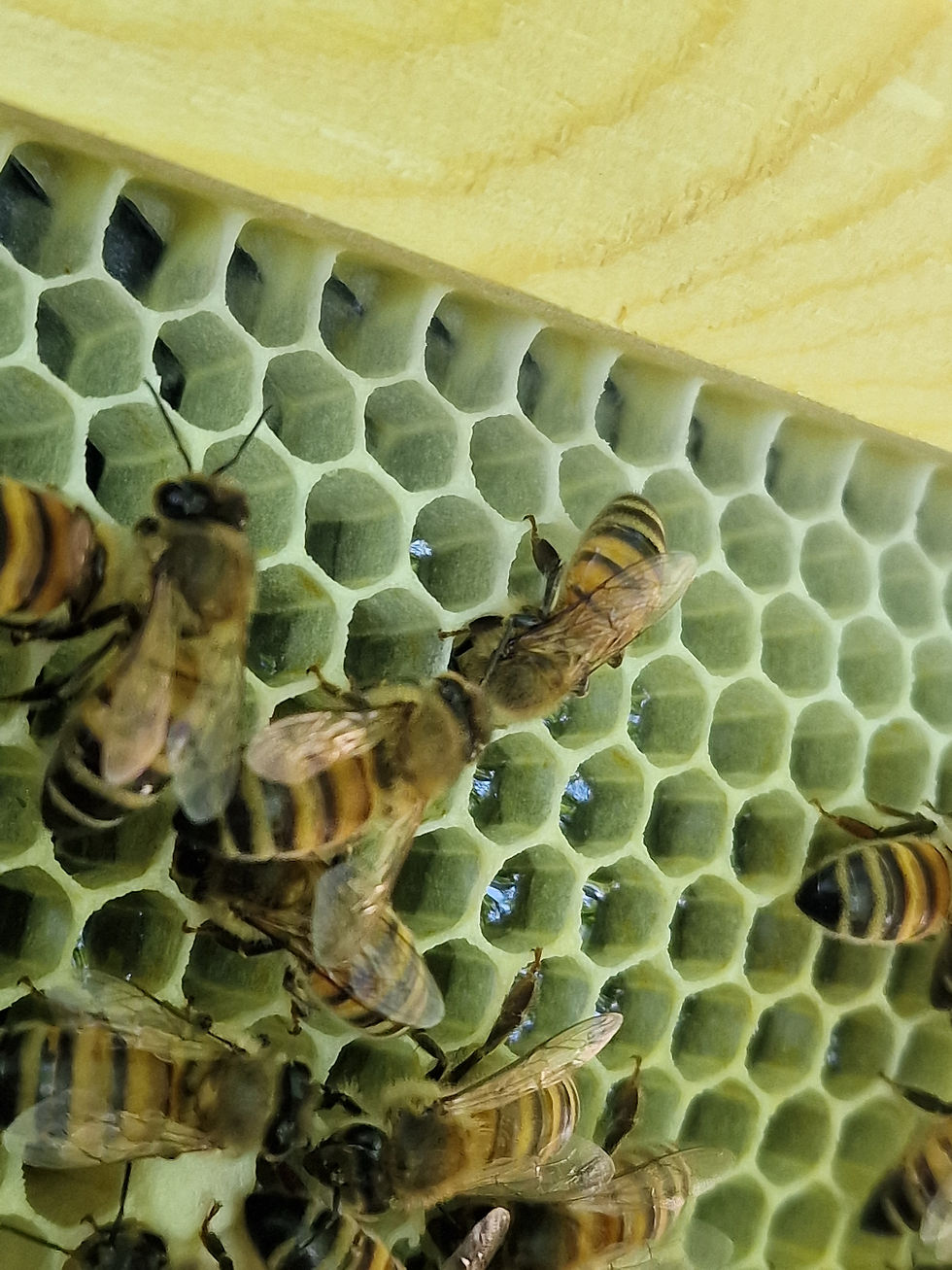
Before thousands of little feet have walked across it, before pollen has been stored in it, before brood has developed inside it and before propolis has worked its way into it, fresh comb can be incredibly pale: creamy white, sometimes almost brilliant white.
The individual wax scales from which it is built are paler still: tiny, thin, almost colourless flakes.
So perhaps the best way to think about new beeswax is as a blank canvas.
Or, to use a considerably less poetic comparison, a brand-new white car.
It looks immaculate when you first get it.
Then you actually use it.
Rain. Dust. Mud. Road grime. A bird inevitably contributes. And if you live in Scotland, the weather normally gets involved approximately four minutes after you've washed it.
The car hasn't fundamentally changed. It's simply acquired a history.
Honeycomb does something remarkably similar.
Not because the hive is dirty, and not because great clouds of pollen dust are floating around staining everything yellow. The real process is much more interesting.
Wax acquires a history.
Imagine, for a moment, standing inside a honey bee colony at bee scale.
It wouldn't be a quiet little wax warehouse. It would be a city.
During the active season, tens of thousands of animals may be moving through an enclosed space. Foragers arrive constantly from the outside world carrying nectar, pollen, water and plant resins. Other workers are feeding larvae, processing nectar, cleaning cells, grooming one another, maintaining the nest, tending the queen and building or repairing comb.
Everything is touching everything else.
And everything coming through the entrance carries a tiny piece of the landscape outside with it.
Pollen is a particularly obvious example because pollen isn't simply yellow. Watch returning foragers closely and you can sometimes see an extraordinary palette packed onto their hind legs: pale cream, mustard yellow, brilliant orange, greenish grey, brown and occasionally much darker shades.
Part of that colour comes from plant pigments, including carotenoids. Their composition varies between plant species, and pollen-associated pigments can become incorporated into beeswax as comb is used. [1–3]
So already our white wax is beginning to change.
But pollen isn't travelling through this city alone.
Honey bees also collect sticky plant resins, often from buds and damaged plant tissue, and bring them home to produce propolis.
Calling propolis "bee glue" is convenient but rather undersells it. Bees use it to seal gaps, modify and line surfaces and help maintain the environment of the nest. And, just like pollen, propolis doesn't come in one standard colour. Depending on its botanical origin, it can range through yellows, reds, greens and browns to material so dark it appears almost black. Its colour reflects a complicated mixture of plant-derived compounds, including flavonoids and other phenolic substances. [4]
Put wax, pollen and propolis together inside a warm colony occupied by thousands of bees and our pristine white building material doesn't remain pristine for very long.
White becomes cream.
Cream becomes yellow.
Yellow deepens into gold.
And if we leave it there for long enough, gold eventually becomes brown.
Sometimes almost black.
This is particularly obvious in brood comb.
Every worker bee begins life at the bottom of one of those cells. Egg becomes larva; larva grows; eventually it spins a cocoon and pupates. The adult bee emerges, but the cell isn't magically restored to factory condition.
Some cocoon material remains behind.
Then the queen may lay another egg in it.
Another larva.
Another cocoon.
Another bee.
Again.
And again.
And again.
Over successive generations, layers accumulate. Research on ageing brood comb shows that repeated brood cycles don't merely change its colour; material building up on the cell walls can actually reduce the internal dimensions of the cells. [5]
So that nearly black frame in an old hive isn't simply "really dark beeswax".
It's more like a biological archive.
Generation after generation has quite literally left something behind.
Rather like tree rings, except substantially more disgusting if you think too hard about what the rings are made of.
It's one reason beekeepers periodically rotate particularly old brood comb out of their colonies. Older comb changes physically and can accumulate residues and environmental contaminants over time. [5]
But here's the lovely thing.
Remove that dark frame, melt it and filter it, and much of that accumulated material can be separated from the wax itself.
Something produced beneath the abdomen of a bee became a nursery wall, raised generations of bees, gradually turned almost black and can now be recovered and given another life.
Perhaps as polish.
Perhaps as fresh foundation.
Or perhaps, in my case, as a candle.
And you'd think that would complete our colour story.
Fresh wax starts pale, hive life gradually makes it yellow, and repeated use eventually makes it darker.
Simple enough.
Except I'd already noticed something on my own shelves that seemed to contradict it.
I'll pour a fresh batch of candles and they'll have that lovely rich golden-yellow colour.
Months later, I'll pick up one that's been sitting on display and think:
Hang on. You definitely weren't that pale when I made you.
Apparently wax gets darker as it gets older...
and lighter as it gets older?
Oddly enough, both are true.
The difference is what we mean by "getting older".
Inside the hive, coloured materials are being incorporated into the comb. Pollen, propolis and the accumulated products of colony life are adding to its history.
Once that wax has been rendered, filtered and turned into a candle, that particular process largely stops.
Now another process takes over.
Light starts taking some of the colour away.
Many of the natural compounds contributing to yellow beeswax aren't perfectly light-stable. Exposure to light, particularly its higher-energy ultraviolet component, can gradually alter some of those molecules.
This is photodegradation.
Colour itself is really a trick of chemistry and light. A molecule appears coloured because its structure causes it to absorb some wavelengths of visible light while allowing or reflecting others towards our eyes. Alter that structure and you can alter the colour we perceive.
So the yellow isn't somehow evaporating out of the candle.
Some of the chemistry responsible for making it look yellow is changing.
Experimental ageing of beeswax under UV-visible radiation has produced measurable bleaching and chemical changes, and colour changes have also been observed during much gentler ageing under natural window-filtered light.
Which explains my shelf.
A candle poured today and one poured months ago from the same wax may genuinely no longer look identical.
The older candle has quietly spent months interacting with light, oxygen, temperature and its surroundings. The change happens slowly enough that you may never notice it.
Until you put a freshly poured candle beside it.
Then suddenly it's obvious.
And there's a wonderfully simple experiment hiding here.
Pour two candles from the same batch. Leave one somewhere exposed to daylight and put the other inside a closed box. Forget about them for a few months, then place them side by side.
The light-exposed candle should have lost more of its original golden colour.
So even two candles made from exactly the same wax don't necessarily have to remain identical forever.
One may simply have seen considerably more of the world than the other.
We've now followed beeswax from almost white, through yellow and gold, into the near-black of an old brood frame, then watched rendered wax slowly become paler again on a shelf.
Which raises a rather more fundamental question.
We've spent all this time talking about what happens to beeswax.
Where did the wax come from in the first place?
Making a building material inside your own body
Honey and beeswax tend to get bundled together as "things bees make", but their origins are quite different.
Honey begins with something collected from the outside world.
Beeswax begins inside the bee.
Worker honey bees possess four pairs of specialised wax glands associated with the underside of their abdomen. Wax secreted by these glands appears on smooth areas called wax mirrors, where it forms tiny flattened scales. [6]

Eight wax-producing areas.
Eight little opportunities for a bee to become a biological 3D printer.
The glands aren't equally active throughout a worker's entire life. Honey bee society has a flexible age-related division of labour, with younger adults generally performing more work inside the nest before eventually transitioning towards jobs such as guarding and foraging.
Wax production broadly fits that pattern. Wax glands develop strongly in relatively young workers and later regress, although honey bee physiology is wonderfully flexible and can respond to the needs of the colony. [6]
Picture one of those younger workers hanging among a mass of bees where new comb is being constructed.
A tiny wax scale forms beneath her abdomen.
Now she somehow has to get a building material produced underneath her backside all the way to the construction site at her mouth.
Workers retrieve the scales using their legs, transfer them forwards and manipulate the wax with their mandibles. [7]
It is worked.
Kneaded.
Placed.
Adjusted.
Removed.
Shaved.
Added to again.
And importantly, this isn't one bee neatly finishing Cell Number 12,439 before moving on to Cell Number 12,440.
Honeycomb is a collective construction project.
Different workers contribute to the same developing structure. Wax can be added and removed, walls refined, and existing wax reworked and transported elsewhere. Detailed observations have even recorded bees handling both fresh wax scales and reworked, string-like pieces of wax during construction. [7]
The little scale is only the raw material.
What follows is manufacturing.
Fine.
The bee's wax glands make wax.
But saying that is rather like answering "Where does a car come from?" with:
"A factory."
Technically correct.
Not particularly satisfying.
What is the factory actually using?
Ultimately, we find ourselves back outside the hive.
Flowers produce nectar.
Bees collect it.
The colony converts and stores carbohydrates.
Workers consume them.
Their metabolism supplies the carbon and energy required to synthesise the lipids that ultimately become wax.
Wax becomes comb.
Comb becomes the container in which more honey is stored.
Food becomes architecture, which becomes storage for food.
Nature does enjoy recycling an idea.
Chemically, though, "wax" makes this sound deceptively simple.
Apis mellifera beeswax contains hundreds of chemical constituents, dominated by esters alongside hydrocarbons, free fatty acids, alcohols and numerous minor components. [1]
That mixture gives beeswax a particularly useful set of physical properties.
At ordinary temperatures it is solid.
Warm it and it becomes increasingly pliable.
Heat it into roughly the low-to-mid 60°C range and it melts, with the exact behaviour depending upon its composition. [1]
It is hydrophobic, meaning it doesn't readily mix with water, rather useful for a structure in which huge quantities of watery nectar are being processed.
And it is thermoplastic.
Warmth changes how easily it can be shaped.
Which is interesting, because the bees aren't just making random blobs out of it.
They repeatedly turn it into one of the most recognisable structures in nature.
The hexagon.
The bees were unavailable for comment
Humans have been staring at honeycomb and wondering about its geometry for a very long time.
The Greek mathematician Pappus of Alexandria was discussing the efficiency of honeycomb in the fourth century AD. Much later, the mathematical problem became formalised in what we now call the Honeycomb Conjecture: roughly speaking, if you want to divide a flat surface into equal areas while using the least total boundary length, the familiar hexagonal arrangement wins. [8]
The proof arrived in 1999.
The bees had, by that point, been using the solution for rather longer.
They were unavailable for comment.
At first the explanation seems wonderfully simple.
Circles leave gaps.
Squares fill space but don't approximate the rounded body of a developing bee particularly well.
Triangles tile perfectly but produce another rather awkward interior.
Hexagons tile without gaps, approximate a circle reasonably well and allow neighbouring cells to share walls.
And if your workers have to manufacture the building material metabolically, using less wall to enclose more useful space is a very good deal.
Charles Darwin himself considered honeycomb efficiency through natural selection. Bees don't need to know that their construction is mathematically economical. Colonies whose inherited behaviours produce useful comb while wasting less energy and wax can simply outperform those that build less efficiently.
A spider doesn't solve tensile-force equations before building a web.
A bee doesn't need a geometry qualification.
Great.
We've explained why hexagons are useful.
We still haven't explained how a bee makes one.
And this is where the tidy schoolbook story begins to unravel.
Some studies of developing honeycomb have suggested that cells begin substantially circular, becoming the familiar rounded hexagons only afterwards. [9]
Imagine a series of closely packed circular tubes.
Where neighbouring walls touch, the wax is warmed and softened. One proposed mechanism suggests that the viscoelastic wax can deform and fuse at these junctions, with physical forces helping straighten the contacting walls.
A circle develops flat sides.
Do that around the cell and a rounded hexagon emerges.
Which gives us an extraordinarily elegant answer:
the bees make circles and physics finishes the hexagons.
Lovely.
Mystery solved.
Except, naturally, scientists started arguing about it.
Other researchers have questioned whether wax is heated sufficiently for a simple surface-tension explanation to do all the work and have emphasised active construction by the bees themselves.
Francesco Nazzi pointed out another wonderfully simple problem with the purely physical explanation: however the walls eventually straighten, a cell only ends up with six sides if it was correctly positioned among six neighbouring cells to begin with. Mistakes in that arrangement can result in five-, seven- and otherwise irregular-sided cells. [10]
Physics can't rescue a badly planned neighbourhood.
So the more interesting answer appears to sit somewhere between the extremes.
Bees aren't tiny mathematicians carefully measuring 120° angles.
But neither are they simply producing random circles and leaving the rest to surface tension.
Honeycomb seems to emerge from an interaction between bee behaviour, cell positioning, wax properties, temperature, repeated local construction rules and physical forces. The exact contribution of each is still discussed. [9–11]
And I rather like that.
The bee doesn't understand geometry.
The wax doesn't understand bees.
Yet put the behaviour of one together with the physics of the other and a honeycomb emerges.
And we're still only looking at it from the front.
Turn a frame sideways and things become stranger.
Cells extend into the comb from both sides, with their bases arranged together in three dimensions. Worker and drone cells differ in size because they house differently sized bees. Queen cells abandon the normal arrangement even more dramatically, becoming the large downward-facing structures familiar to beekeepers.
So bees clearly aren't compelled to make one universal wax shape.
Architecture changes with function.
And once you realise that, calling honeycomb "storage" begins to feel rather inadequate.
A hive doesn't simply live on its comb
Comb is not passive furniture.
The colony lives through it.
Mechanical vibrations travel through wax and are involved in honey bee communication.
Chemical compounds associated with the colony become incorporated into comb, meaning wax contributes to the chemical environment by which bees recognise their nest and nestmates. [1]
Even the thin wax cappings covering cells can be tailored to different jobs.
Brood cappings are porous and considerably more permeable to gases such as carbon dioxide than honey cappings. [12]
Which, when you think about it, is obvious.
Honey doesn't breathe.
A developing bee does.
Same basic building material.
Different job.
Different engineering.
At this point we've spent an unreasonable amount of time admiring the engineering of one particular bee:
Apis mellifera, the western honey bee.
But there are thousands of bee species.
Surely they don't all build like this?
They don't.
And this is where the story of beeswax stops being about one clever material and starts becoming a story about evolution finding multiple solutions to the same problem.
There is more than one way to build a bee's house
Even within the genus Apis, beeswax isn't chemically identical. Comparative analyses have found differences between the waxes of western honey bees, Asian honey bees, dwarf honey bees and giant honey bees. [1]
Move further through the bee family tree and the architecture changes far more dramatically.
Bumblebees produce wax too, but a bumblebee nest looks nothing like the beautifully ordered, double-sided vertical comb of a honey bee colony.
Brood structures sit in clusters. Food-storage vessels are arranged around them. Different species incorporate wax, pollen and surrounding nesting materials into surprisingly complicated structures.
One study of Bombus morrisoni, for example, described a thin wax canopy extending across the nest which contained an estimated 40 million pollen grains within only 19 grams of material. [13]
Honey bees sometimes feel like they've built the bee equivalent of a meticulously planned city grid.
Bumblebees built the medieval town.
Both work.
Different colony sizes, nesting environments, annual cycles and evolutionary histories simply produced different solutions.
Travel into tropical and subtropical regions and the stingless bees take us somewhere else again.
Many stingless bees mix their own wax with collected plant resins to create a composite building material called cerumen. [14]
Now we're getting into materials engineering.
Wax supplies one set of properties.
Resin supplies another.
Mix them and the resulting material can be better suited to the nest the colony needs to build.
Stingless bees use cerumen to make brood structures, pollen stores, honey pots, walls and protective nest structures. Some incorporate soil or clay into resinous materials to make geopropolis. Nest entrances can become elaborate tubes and structures that barely resemble anything a British beekeeper would immediately identify as a bee nest. [14]
Suddenly our sheet of golden hexagonal comb stops looking like the way bees build.
It's simply one way bees build.
And if different bees can arrive at completely different architectural solutions, what did their close relatives do?
Enter the wasps.
They looked at wax...
and apparently decided to chew up your fence instead.
Bees make wax. Wasps make paper.
A social-wasp nest can look strangely familiar.
Hexagonal cells.
Layered comb.
Social insects tending brood.
But touch the abandoned nest and the similarity disappears.
It's paper.
Many social wasps collect weathered wood and other cellulose-rich plant fibres, scrape them away with their mandibles and chew the fibres together with oral secretions. The resulting pulp is shaped into the nest and allowed to dry. [15]
Essentially, papier-mâché.
Before humans invented papermaking, wasps had already stumbled onto the basic manufacturing process.
And if you look closely at some nests, you can see bands of slightly different colours where the workers have collected different sources of fibre.
A dead branch.
A weathered fence.
An old shed.
Each contributes a slightly different shade.
The finished nest becomes a geological record of stolen garden furniture.
Why did bees manufacture wax while wasps adopted paper?
Evolution rarely gives us one neat reason, but the different lifestyles make the trade-off fascinating.
Honey bees manufacture their primary structural material metabolically. That's expensive, but wax is mouldable, hydrophobic and extraordinarily useful for constructing a perennial nest containing long-term stores of liquid food.
Paper wasps largely outsource the production of their raw material to trees.
Wood is everywhere.
Scrape it up, chew it, reshape it.
Many familiar temperate social-wasp colonies are annual. The queen starts a nest in spring, the colony grows through summer and the structure is eventually abandoned when the seasonal colony dies away.
A honey bee colony, by contrast, is perennial. The city needs to survive winter and remain useful year after year.
If your city only needs to last a season, perhaps you build it differently from one intended to house generation after generation.
Architecture follows biology.
Could a honey bee build a paper nest if we gave it enough wood?
Probably not in any meaningful natural sense.
It possesses mandibles. It can manipulate material. But evolution hasn't equipped it with the physiology and inherited construction behaviour of a paper wasp.
Likewise, giving a wasp unlimited honey won't suddenly cause it to develop abdominal wax glands.
The nest is almost an extension of the animal itself, what evolutionary biology sometimes calls an extended phenotype.
Genes influence bodies and nervous systems.
Bodies produce behaviour.
Behaviour modifies the environment.
And the modified environment becomes the nest.
A honeycomb is, in that sense, bee biology continuing beyond the physical edge of the bee.
Which is all getting rather philosophical.
So let's talk about earwax.
Right. Earwax.
Bees secrete a pale waxy substance from glands on their bodies.
Humans secrete a yellowish waxy substance from glands in our ears.
Therefore...
why aren't we making candles out of ourselves?
This is the sort of question that should probably be left alone.
Unfortunately, here we are.
Human earwax, properly called cerumen, genuinely does contain waxy lipids, including wax esters, so the name isn't entirely fraudulent.
But it is not human beeswax.
Cerumen is a complicated mixture of glandular secretions, lipids, shed skin cells and other biological material. Beeswax, meanwhile, evolved specifically as a structural material.
One becomes honeycomb.
The other catches dust in your ear.
Different career paths.
But could you collect enough earwax to make a candle?
To answer that question, we first have to ask something surprisingly interesting.
What actually burns in a candle?
It isn't really the wick.
When a candle is lit, heat melts wax around the wick. The liquid wax travels upwards through the fibres by capillary action. As it approaches the flame it becomes hot enough to vaporise, and it is primarily this wax vapour that combusts.
That combustion produces heat.
The heat melts more wax.
More liquid climbs the wick.
More vapour forms.
More burns.
The candle is a beautifully simple self-feeding fuel-delivery system.
Beeswax happens to be remarkably well suited to it: solid enough to hold its shape at room temperature, able to melt into a controlled liquid pool, energy-rich, mouldable and relatively stable.
Raw earwax, unsurprisingly, is not nearly as cooperative.
Could humanity potentially isolate enough combustible lipids from a grotesque quantity of earwax and engineer something that burned?
Probably.
Is "technically capable of catching fire" a sensible standard by which to choose candle materials?
No.
Fortunately, humans discovered an alternative rather a long time ago.
We simply stole the bees'.
Then humans got involved
And when I say a long time ago, I mean it.
In 2015, researchers examined chemical residues preserved inside Neolithic pottery from sites across Europe, the Near East and North Africa.
Beeswax leaves a distinctive lipid fingerprint behind.
Honey disappears.
Organic material decomposes.
But under the right conditions, traces of those resistant wax compounds can survive for thousands of years.
The researchers found evidence showing that humans were exploiting honey bee products by at least the seventh millennium BC. [16]
Roughly 9,000 years ago.
Before Stonehenge.
Before the Great Pyramid.
Before writing had emerged in many parts of the world.
Early farming communities were already bothering bees.
Probably for honey.
Probably for wax.
And once you have a lump of beeswax in your hand, it isn't difficult to understand why it remained useful.
Warm it and it softens.
Cool it and it retains its shape.
Warm it again and you can rework it.
It repels water.
It coats surfaces.
It fills gaps.
It polishes.
It protects.
Before silicone sealants, paraffin, synthetic resins and petroleum-derived plastics, beeswax was an extraordinarily versatile material technology.
In that sense, you could almost call it a prehistoric plastic.
Humans used wax for waterproofing and sealing, surface treatments, cosmetics and medicines, polishing, adhesives, modelling, artwork and eventually candles.
Wax could even hold information.
Ancient writing tablets consisted of a recessed wooden board containing a layer of wax. Scratch words into it with a stylus; when you no longer need them, smooth the wax and use it again. Archaeological evidence shows beeswax being used in ancient writing boards.[17]
Thousands of years before cloud storage, someone was saving information in bee secretions.
And then somebody worked out that you could use wax to make something that wasn't wax at all.
In lost-wax casting, an object is first sculpted in wax. A heat-resistant mould is formed around it and heated, allowing the wax to melt and escape. Molten metal is then poured into the empty space.
Once the metal cools, the mould is removed.
The wax sculpture has effectively become metal.
Think about the journey involved there.
A worker bee produces wax because her colony needs somewhere to raise brood.
A human takes advantage of the same material properties to manufacture a bronze object.
Evolution rarely knows where its inventions are going.
And after thousands of years of us inventing newer and more specialised materials, beeswax still hasn't disappeared.
It's still used in cosmetics, pharmaceuticals, food applications, art, polishes, coatings and candles. [18]
Partly because its combination of physical properties remains useful.
But I suspect there's another reason we remain so attached to natural beeswax.
It still feels like it came from somewhere.
It smells like it came from somewhere.
And, as we've now discovered, it looks like it came from somewhere.
A little piece of the hive
Natural beeswax doesn't have one exact colour.
There is no universal Pantone code for "beeswax yellow".
It can be nearly white.
Cream.
Lemon yellow.
Deep gold.
Amber.
Brown.
And, in an old brood frame before rendering, nearly black.

Botanical environment matters.
Pollen matters.
Propolis matters.
How the comb was used matters.
Its age matters.
The species of bee matters.
How the beekeeper renders and filters it matters.
Heat and processing matter.
And once the finished wax is sitting on a shelf, light matters too.
The same is true of its aroma. Natural beeswax contains numerous minor volatile compounds, and the smell we associate with it is influenced by its complicated history among honey, pollen, propolis and the other materials of the hive.
So perhaps variation isn't an imperfection in natural beeswax.
Perhaps expecting a natural material to be perfectly identical every time is the stranger idea.
I started this article with what seemed like a very small question.
Why is beeswax yellow?
The answer could have been a paragraph.
Pollen. Propolis. Plant pigments. There you go.
Except then you ask where the wax came from.
So you end up underneath the abdomen of a worker bee.
Then you ask what she made it from.
Now we're talking about metabolism and lipid chemistry.
Then you wonder why she arranged it into hexagons.
Suddenly we're doing mathematics, materials science, animal behaviour and evolution, and even the scientists can't agree completely on where the bee's work ends and the physics begins.
Then you discover other bees don't necessarily build that way at all.
Bumblebees build something resembling a medieval town.
Stingless bees mix their wax with resin.
Wasps chew your garden fence into papier-mâché.
Then, for reasons that seemed perfectly sensible at the time, you start wondering whether human earwax could fuel a candle.
And somehow that leads to Neolithic pottery, ancient writing tablets and bronze casting.
All because we asked why beeswax is yellow.
But perhaps that's what makes a simple beeswax candle rather wonderful.
Before it became a candle, the material was manufactured inside an insect.
Before that, its carbon ultimately came from plants.
Those plants took carbon from the atmosphere and, powered by sunlight, built sugars.
A bee collected those sugars.
Her body transformed some of that food into wax.
The colony transformed the wax into architecture.
That architecture stored food and raised life.
As it was used, the wax acquired the colours and smells of the hive around it.
Eventually some of it was removed.
Melted.
Filtered.
Poured.
A wick was added.
And finally, you light it.
The material that once formed part of a dark, warm honey bee colony is transformed once again.
This time into heat and light.
And suddenly that little golden candle sitting on the table has a rather ridiculous backstory.
Not bad for something that started life as a nearly colourless scale underneath a bee.
Although...
why does a candle flame have that shape?
Perhaps that's another rabbit hole.
References & further reading
[1] Svečnjak, L., Chesson, L.A., Gallina, A., Maia, M., Martinello, M., Mutinelli, F., Muz, M.N., Nunes, F.M., Saucy, F., Tipple, B.J., Wallner, K., Waś, E. & Waters, T.A. (2019). Standard methods for Apis mellifera beeswax research. Journal of Apicultural Research, 58(2), 1–108. DOI: 10.1080/00218839.2019.1571556.
[2] de Groot, A.C., Ipenburg, N.A. & Rustemeyer, T. (2026). Propolis and Beeswax in Cosmetics: A Market Survey and Literature Review on Their Relationship and Role in Allergic Contact Dermatitis. Contact Dermatitis, 94, 494–503. DOI: 10.1111/cod.70108.
[3] Thakur, M. & Nanda, V. (2020). Composition and functionality of bee pollen: A review. Trends in Food Science & Technology, 98, 82–106. DOI: 10.1016/j.tifs.2020.02.001.
[4] Toreti, V.C., Sato, H.H., Pastore, G.M. & Park, Y.K. (2013). Recent Progress of Propolis for Its Biological and Chemical Compositions and Its Botanical Origin. Evidence-Based Complementary and Alternative Medicine, 2013, 697390. DOI: 10.1155/2013/697390.
[5] Meng, Q., Huang, R., Yang, S., Jiang, W., Tian, Y. & Dong, K. (2025). An Overview of the Adverse Impacts of Old Combs on Honeybee Colonies and Recommended Beekeeping Management Strategies. Insects, 16(4), 351. DOI: 10.3390/insects16040351.
[6] Hepburn, H.R., Pirk, C.W.W. & Duangphakdee, O. (2014). Honeybee Nests: Composition, Structure, Function. Berlin/Heidelberg: Springer. DOI: 10.1007/978-3-642-54328-9.
[7] Siefert, P., Buling, N. & Grünewald, B. (2021). Honey bee behaviours within the hive: Insights from long-term video analysis. PLOS ONE, 16(3), e0247323. DOI: 10.1371/journal.pone.0247323.
[8] Hales, T.C. (2001). The Honeycomb Conjecture. Discrete & Computational Geometry, 25(1), 1–22. DOI: 10.1007/s004540010071.
[9] Karihaloo, B.L., Zhang, K. & Wang, J. (2013). Honeybee combs: how the circular cells transform into rounded hexagons. Journal of the Royal Society Interface, 10(86), 20130299. DOI: 10.1098/rsif.2013.0299.
[10] Nazzi, F. (2016). The hexagonal shape of the honeycomb cells depends on the construction behavior of bees. Scientific Reports, 6, 28341. DOI: 10.1038/srep28341.
[11] Narumi, T., Uemichi, K., Honda, H. & Osaki, K. (2018). Self-organization at the first stage of honeycomb construction: Analysis of an attachment-excavation model. PLOS ONE, 13(10), e0205353. DOI: 10.1371/journal.pone.0205353.
[12] Kubásek, J., Svobodová, K., Půta, F. & Bruce Krejčí, A. (2022). Honeybees control the gas permeability of brood and honey cappings. iScience, 25(11), 105445. DOI: 10.1016/j.isci.2022.105445.
[13] Koch, J.B.U. & Cane, J.H. (2022). Pollen columns and a wax canopy in a first nest description of Bombus (Cullumanobombus) morrisoni (Apidae). Apidologie, 53, 31. DOI: 10.1007/s13592-022-00943-4.
[14] Shanahan, M. & Spivak, M. (2021). Resin Use by Stingless Bees: A Review. Insects, 12(8), 719. DOI: 10.3390/insects12080719.
[15] Namin, S.M., Son, M. & Jung, C. (2024). Uncovering floral composition of paper wasp nests (Hymenoptera: Vespidae: Polistes) through DNA metabarcoding. Scientific Reports, 14, 2830. DOI: 10.1038/s41598-024-52834-6.
[16] Roffet-Salque, M., Regert, M., Evershed, R.P. et al. (2015). Widespread exploitation of the honeybee by early Neolithic farmers. Nature, 527, 226–230. DOI: 10.1038/nature15757.
[17] Boyes, P.J. (2023). The Wider World of Writing: Networks of People, Practice and Culture Underpinning Writing in Late Bronze Age Ugarit. Cambridge Archaeological Journal, 33(2), 181–192. DOI: 10.1017/S0959774322000245.
[18] Beeswax in Pharmaceutical Sciences: A Comprehensive Review of Its Chemical Composition, Functional Applications, Types, and Formulation Roles (2026). International Journal of Molecular Sciences, 27(8), 3486.
[19] A comparative study on the artificial UV and natural ageing of beeswax and Chinese wax and influence of wax finishing on the ageing of Chinese Ash (Fraxinus mandshurica) wood surfaces (2019). Journal of Photochemistry and Photobiology B: Biology, 201, 111607. DOI: 10.1016/j.jphotobiol.2019.111607.


Comments